

‘The 47 Ronin: Hiroshige and the Utagawa School’ opens to the public on Thursday 30 April. This temporary exhibition tells the story of the 47 ronin’s act of vengeance in 1702, when a group of masterless samurai avenged the death of their lord after two years of waiting. Aware that they were breaking the shōgun’s law, the rōnin accepted their sentence of seppuku, becoming a symbol of loyalty and honour.
Their story quickly became a popular legend, adapted for the Japanese theatre, particularly in kabuki, with the famous play Kanadehon Chūshingura. At the same time, ukiyo-e woodblock prints helped to disseminate and reinterpret the story, expanding its iconographic reach. The exhibition offers an insight into how a historical episode has, over time, become a powerful visual and theatrical narrative, capable of spanning the centuries and continuing to speak to contemporary audiences. On display are three series of woodblock prints created in the mid-19th century by three artists of the Utagawa School: Hiroshige (1797–1858), Shigenobu (1826–1869) and Kuniteru (active around the mid-19th century). The latter come from the Marco Fagioli Archive, whilst the works by the other two artists are from the Perino Collection.
The exhibition is open to the public until 4 October 2026.
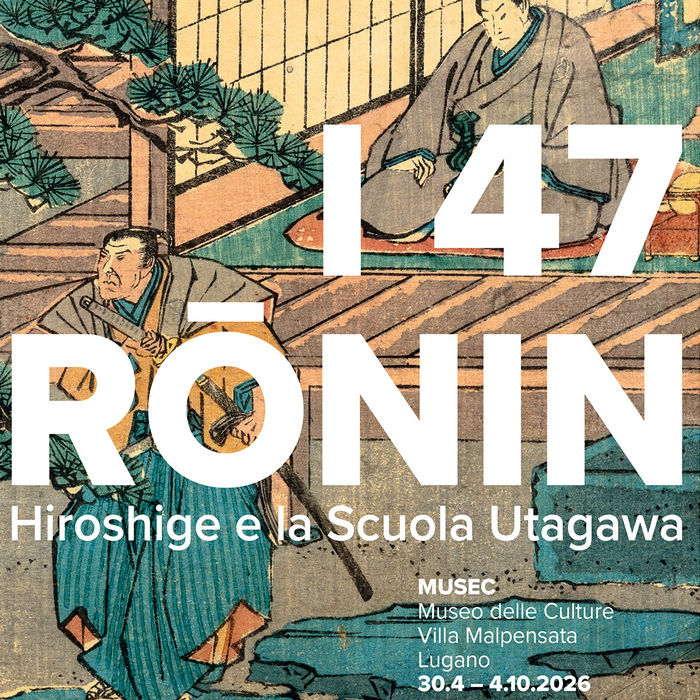
‘The 47 Ronin: Hiroshige and the Utagawa School’ opens to the public on Thursday 30 April. This temporary exhibition tells the story of the 47 ronin’s act of vengeance in 1702, when a group of masterless samurai avenged the death of their lord after two years of waiting. Aware that they were breaking the shōgun’s law, the rōnin accepted their sentence of seppuku, becoming a symbol of loyalty and honour.
Their story quickly became a popular legend, adapted for the Japanese theatre, particularly in kabuki, with the famous play Kanadehon Chūshingura. At the same time, ukiyo-e woodblock prints helped to disseminate and reinterpret the story, expanding its iconographic reach. The exhibition offers an insight into how a historical episode has, over time, become a powerful visual and theatrical narrative, capable of spanning the centuries and continuing to speak to contemporary audiences. On display are three series of woodblock prints created in the mid-19th century by three artists of the Utagawa School: Hiroshige (1797–1858), Shigenobu (1826–1869) and Kuniteru (active around the mid-19th century). The latter come from the Marco Fagioli Archive, whilst the works by the other two artists are from the Perino Collection.
The exhibition is open to the public until 4 October 2026.